
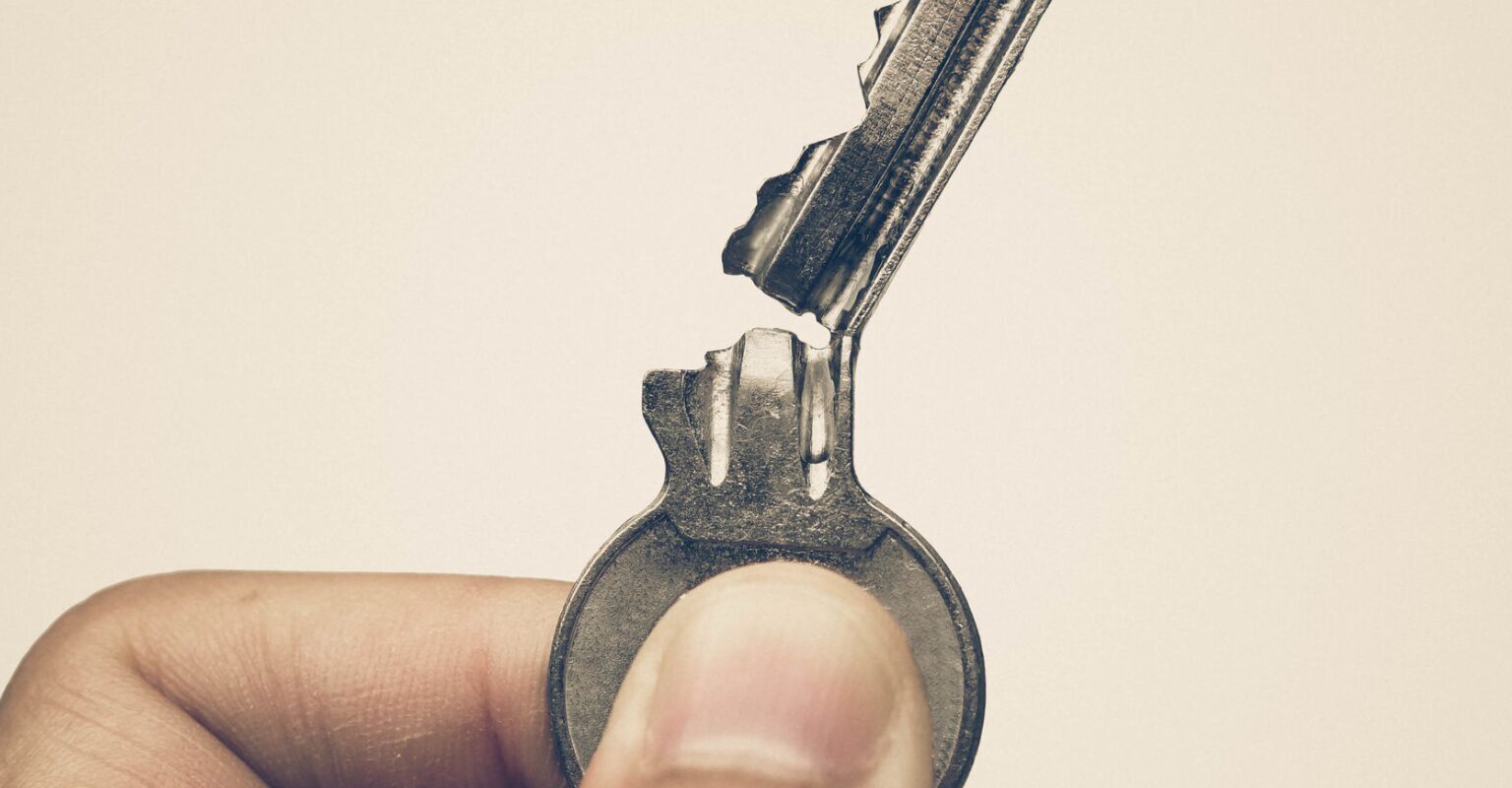
Key broken in lock
If your key has ever broken in a lock, you’ll know how frustrating it can be. While your first instinct may be to try and remove it yourself, attempting to dislodge it with tweezers, a hair pin or another makeshift tool could actually make things worse. In this guide, we’ll outline the common causes of key breakage, explore methods of removing the key and consider what services you may need once the extraction is complete.
Why has my key broken in the lock?
Before you attempt to remove a broken key in a lock it can be useful to understand why this has happened in the first place. Knowing the causes of a snapped key in a lock can help prevent it from occurring again. Reasons for a broken key include:
- Attempting to force open a jammed lock
- Attempting to turn the key when it’s not fully inserted
- Attempting to use the incorrect key
- Inserting the key into a damaged or poorly maintained lock
- General wear and tear on the key, particularly if it’s made of a softer metal such as brass
- Holding the key while pushing the door open, causing it to bend and then break
- Damage to the key caused by using it to open boxes or tins of paint
DIY key extraction methods
While there are ways to extract a broken key in a lock yourself, they often require you to have certain tools or materials handy. If you habitually carry a pair of tweezers, metal hair pins or safety pins, you may be able to remove a key that has snapped.
Preparing the lock before attempting extraction will make the process easier. A graphite spray or other dry lubrication method will work best, as oil-based lubricants can gum up the internal mechanisms of the lock. Put the nozzle of the lubricant to the keyway before spraying and wipe any excess off with a paper towel or rag.
- Tweezers or needle nose pliers
Using tweezers or needle nose pliers to retrieve a key broken in a lock may seem intuitive, but it can in fact make the situation worse. Many tweezers and pliers are inappropriately sized and will only push the key further into the mechanism. Ideally you should only use them if there is a bit of the key protruding from the keyhole.
- Hair pins and paperclips
Sometimes it’s possible to extract a key with two thin pieces of metal, such as hair pins, paperclips or safety pins. You should line up the metal with the left and right sides of the key, apply inward pressure and pull the key towards you. Bit by bit, you may be able to remove it. Again, there is a chance that attempting this could result in the key being pushed further in, or of the tools you’re using becoming stuck in the lock too.
- Jigsaw blade
If you have access to a jigsaw blade, you can break off a portion and insert it along the keyway. You should be able to hook it onto the broken key, turn it and pull it out. You can do this multiple times until the key is removed. This method can be time consuming, however, and of course requires a jigsaw blade to be available in your time of need.
Professional key extraction methods
If you find yourself with a snapped key in the lock, by far the best course of action is to contact a reputable locksmith. A professional locksmith has the tools and expertise to remove stuck keys without damaging the lock mechanism, potentially saving you money on a brand new lock. The best locksmiths will only use a destructive method of key extraction as a last resort, preferring instead to use specialised key extraction techniques, including:
- Broken key extractor
This tool is used by professionals to gently and carefully remove a stuck key. It is placed along the teeth of the key and hooks on, enabling the locksmith to pull it out.
- Tension and wrench techniques
In some cases, tension and wrench techniques may be used to apply pressure to a lock’s cylinder. The professional can then use lock picks to manipulate the key and remove it.
The best way to remove a broken key in a lock depends on the type of lock. A professional can assess the situation and use the appropriate method without causing damage. They can also cut a new key for you either on-site or within 24 hours at their shop. This ensures the security of your lock remains intact and minimises convenience.
If damage to the lock occurs during the process, a professional locksmith will not leave your property unsecured. Instead, they will fit a new, high-quality lock and ensure you feel happy and safe with their service before departing. At Absolute Security Locksmiths, we also provide a free door adjustment service to confirm its integrity with every lock change.
Post-extraction considerations
If your broken key is extracted successfully and without damage to the lock, you may require additional services after it has been removed. Your locksmith will make recommendations based on the condition of the lock, but you may wish to update your products for improved security and function, or invest in lock maintenance to prevent a key from snapping in the future.
Often investment in a high-quality lock and proper maintenance can save you money long-term, helping you to avoid issues later on.
Emergency situations and response
If your key has broken in the lock at night, or you are in a remote area or otherwise vulnerable, calling an emergency locksmith is the best solution. Many professionals, such as the team at Absolute Security locksmiths, offer a 24/7 locksmith callout service. We do not charge an additional fee for this, and will offer you a transparent quote when you contact us.
Get in touch today for assistance with a snapped key in a lock and our trusted team will be on hand to help promptly.